“The fire of a superhuman sensuality, a glow from Hell, had cast its reflection over her senses and she was powerless to resist. Only he, only Don Juan, could awaken in her the erotic madness which she lavished upon him.”
-E.T.A. Hoffmann, “Don Giovanni” (1812), trans. Chistopher Lazare (A.A. Wyn, 1946)
[“Das Feuer einer übermenschlichen Sinnlichkeit, Glut aus der Hölle, durchströmte ihr Innerstes und machte jeden Widerstand vergeblich. Nur er, nur Don Juan konnte den wollüstigen Wahnsinn in ihr entzünden, mit dem sie ihn umfing, der mit der übermächtigen, zerstörenden Wut höllischer Geister im Innern sündigte.”]
“Towards all her fellow-creatures [Donna Anna] presents a coldly correct personality… it would be beneficial to her personal growing-up if she had been pleasantly raped by Don Juan.”
-William Mann, The Operas of Mozart (1977), page 468.
This post is apropos the upcoming new production of Don Giovanni at the Met. There’s one thing I will be watching for very carefully.
Donna Anna, the noblest of the three women in Don Giovanni, tends to have a bad reputation. She is “self-absorbed and aloof” (Edward Dent), “has etiquette where her feelings should be” or is “cardboard” (these citations are from Kristi Brown-Montesano’s excellent Understanding the Women of Mozart’s Operas). Moreover, whatever happened offstage with Giovanni, no one seems to think it was actually rape. The more you look at the text, the more convoluted this reading looks, and its grounding in the assumption that no woman alive could resist Don Giovanni (ignoring the fact that Zerlina ultimately seems to as well) is pretty offensive.
The action of the opera really begins when Donna Anna cries for rescue from a strange man in her bedroom. Her screams attract the attention of her father. He and Don Giovanni (for that is who it is) fight a duel and Don Giovanni kills the old man, thus setting off the opera’s plot. Here it is. (This staging isn’t the best but I chose it because it has English subtitles.)
The entire disturbance is touched off by Anna herself, with her line “Unless you kill me, you have no hope of escaping me.” (“Non sperar, se non m’ucidi, ch’io ti lasci fuggir mai.”) This has been often reinterpreted as, “I want you so bad.” But her following lines, crying out for servants to help catch Giovanni (which, as she must have anticipated, also catch the attention of her father), seem rather to make a secret tryst rather implausible.
The second scene contains this dialogue:
LEPORELLO: Bravo, two pretty deeds!
Force the daughter and kill the father!
DON GIOVANNI: He wanted to fight.
LEPORELLO: But Donna Anna, did she want to?
DON GIOVANNI: Silence, don’t bother me, away unless
you want something too!
Later, Donna Anna recounts the events of the night to her fiancé, Don Ottavio. Her journey through various minor keys in the recitative gives it a tense cast; Don Ottavio tends to respond in a reassuring (or, according to some, gullible) major. She then goes into her aria “Or sai chi l’onore,” wishing for vengeance on her father’s killer and, most importantly, resolving the tension of the recitative in a heated pledge of revenge for the wrongs done onto her.
E.T.A. Hoffmann was one of the earliest and most influential of the “Anna wanted/needed it” school. In his “tale” based on the opera, quoted above (full text in a different translation available here), Anna has both a passion for Giovanni and the potential to become his redeemer. Far from a a villain, the nineteenth century’s Giovanni was a tragic hero, independent, virile, charismatic, etc. Donna Anna receives a Katerina Ismailova-like awakening courtesy of his invasion. (This is generally not seen onstage. Thank goodness for small favors.) In Hoffmann’s telling, Anna then feels massive guilt after her father’s death, which sparks her lust for vengeance:
Even the raging love that consumed her soul with hellish flames, flaring up at the moment of highest gratification, was aglow, now, with annihilating hatred… she feels that only the destruction of Don Juan can bring peace to her mortally troubled soul.
Hoffmann claims to interpret the opera “purely in terms of the music and ignoring the text.”
The idea that Anna just must have felt some passion for Don Giovanni persists in both criticism and staging, though usually in subtler form than William Mann’s astonishing pronouncement that she should be “pleasantly raped.” Funnily enough, some of these analyses also claim to rest on an interpretation of the music rather than the text, but reach very different conclusions from Hoffmann. Alfred Einstein and, most convolutedly, R.B. Moberly (Three Mozart Operas, 1967) read Donna Anna’s narration to Ottavio as deceptive and dishonest (the music supposedly betrays her), and interpret her ambivalence towards Don Ottavio not as grief or trauma but as a telltale sign of her secret passion for Don Giovanni. This analysis was thoroughly demolished by Julian Rushton in his Cambridge Opera Guide to Don Giovanni: “The real indecency here [that Anna cares for Giovanni rather than Ottavio] is to suggest, in line with the worst present-day mores, that she could not care so deeply about her father, nor be horrified by the attempt upon herself.”
Stage productions today often show a Donna Anna secretly in love with Don Giovanni. But they do this with an air of Freudian mystification as to the impulses of Woman. Anna turns up as an enigma who has no idea what she wants. To me this confusion seems quite directly contrary to her portrayal in any part of the opera text. This is a lady who knows exactly who she is and what she wants to do. Making her indecisive and infatuated reinforces a value system where the Don is a hero and woman is weak. I think there’s also a lot of pseudo-empowered “she is uncontrollably attracted to dangerous men and that makes her sexy,” which is all grounded in a big pile of patriarchy, as well as the mind-blowing assumptions cited by Rushton. Besides, isn’t her righteous anger pretty badass already?
To echo Rushton, the real indecency here is how contemporary society just doesn’t take the word of a woman who says she’s been raped seriously. Donna Anna enjoyed it and is just feeling guilty because she revealed herself as a slut. This kind of rape denial shit is an enormous problem for women today everywhere, and this particular interpretation seems to be in line with the worst present-day mores.
For example, consider Anna’s actions here in Martin Kusej’s Salzburg production. I’m aware I’m considering this out of the context of the production, but it is the first scene.
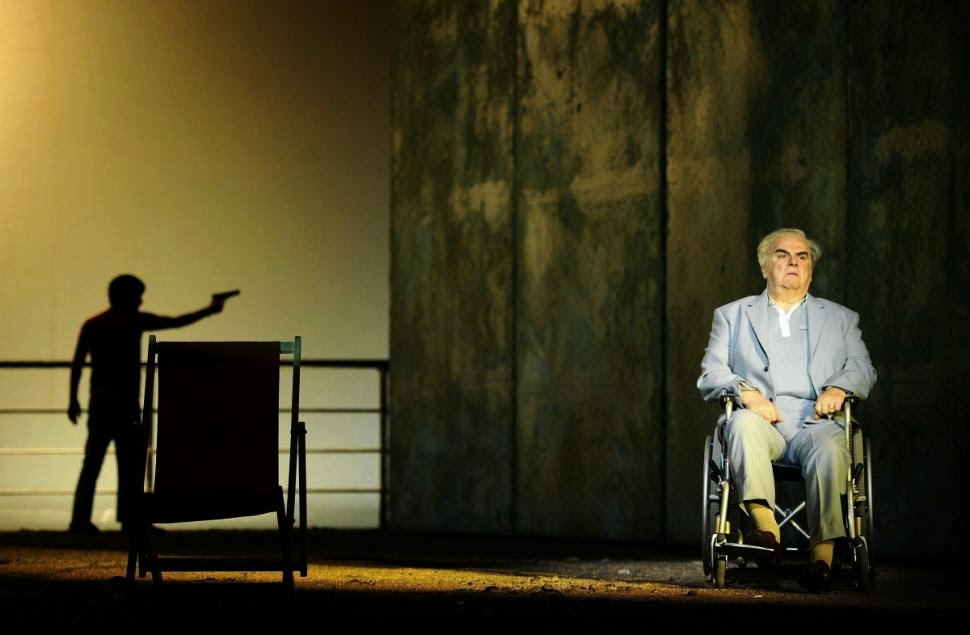
This seems to be fairly typical these days with the exception of some by-the-books traditional productions. Francesca Zambello’s production when I saw it in London had Anna kissing the Don (though it’s done differently on the DVD, interestingly enough), and Jean-Louis Martinoty’s Viennese train wreck last December (pictured at the top of this post) gave her an S&M thing. I find it very disappointing that some productions that seem to have a lot of thought put into them (I am not including Martinoty here) still default to such a reflexively patriarchal portrayal.
Or take Calixto Bieito:
I can’t tell if Renée is entertaining second thoughts here or if this is just poorly staged:
Can’t we consider the Occam’s Razor of emotional decoding, the simplest solution, which is that Don Giovanni attempted or succeeded in raping Donna Anna and she was very angry about this? Apparently it’s not that easy.
Recommended non-patriarchal Don Giovanni reading:
Kristi Brown-Montesano, Understanding the Women of Mozart’s Operas. University of California Press, 2007.
Daniel Heartz, Mozart’s Operas. University of California Press, 1990.
Julian Rushton, Don Giovanni. Cambridge Opera Handbooks, Cambridge University Press, 1981.
Lydia Goehr and Daniel Herwitz, eds. The Don Giovanni Moment. Columbia University Press, 2008.