There are a lot of great things about living in western Massachusetts, but a plethora of places to see live opera is not one of them. The new Berkshire Opera Festival, based in Pittsfield, is trying to change that. Their ambitious and professional production of Madama Butterfly, which opened on Saturday, suggests that their arrival is a welcome one.
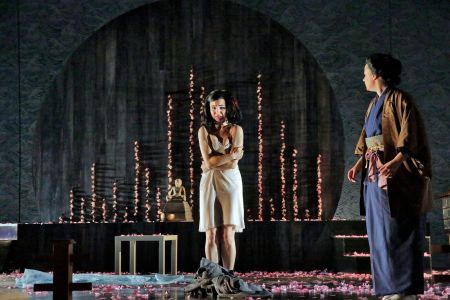
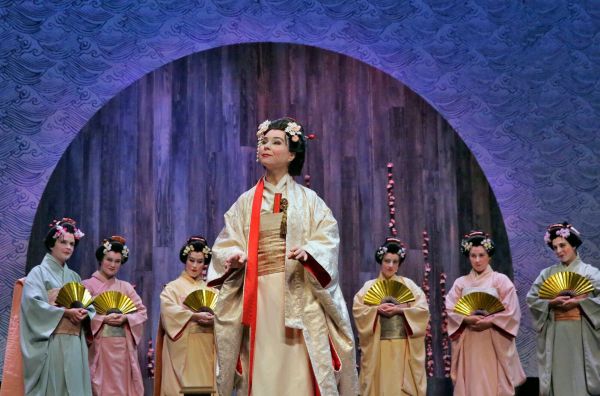
The surprisingly beautiful Colonial Theatre seats 760 and is acoustically excellently suited for this endeavor (it was formerly a touring theater for acts ranging from Sarah Bernhardt to the Ziegfeld Follies). Company General Director Jonathon Loy’s production begins with an extremely traditional Act 1, full of kimonos and screens, belied only by the stark, flat surfaces of Stephen Dobay’s set. Loy and Dobay have gift for tableaus, and use the scrims in the screens and some falling flower petals to beautiful effect. It is, visually, a handsome and polished production. The backdrop hints at mid-century modernism, which comes to the foreground in Act 2. Butterfly sheds her elaborate geisha-wear in favor of a Western-style suit and hairstyle, though Suzuki has not followed her. (The costumes are by Charles Caine.) This shows her dedication to Pinkerton and to American culture in vivid fashion, but I think the political angle is somewhat unexamined? Japanese-American relations in the 1960s were, to say the least, different from those in the original setting of 1904. The production never goes there and it’s an uncomfortable hole. This isn’t a production with politics on its mind, though; Loy’s direction is best in the detailed, careful staging of the dramatic scenes such as the love duet and the Sharpless-Butterfly scene in Act 2.

As Cio-Cio-San, soprano Inna Los started off sounding dry, but she marshaled her resources for a solid “Un bel dì,” revealing a plangent middle range. Her experience in the role is obvious, and most importantly she knows how to hit the emotional high points. Her Butterfly grows over the course of the evening to eventually show intense and steely determination. But she didn’t always seem to be in the same place as the rest of the cast. While the rest acted more or less naturalistically, Los often relied highly stylized vocabulary of “Japanese” gestures and exaggerated reactions, tending to emphasize Cio-Cio San’s childlike naiveté. This approaches racial caricature, and while you could argue that Cio-Cio-San should act differently from everyone else, I thought it seemed awkwardly mannered (I would rather see Cio-Cio-San as a human than as a figment of an imagined Japanese-ness). She tended to drop the schtick for the big moments, though, and she was good enough there that I wish she had done so for the whole opera.

As Pinkerton, Jason Slayden boasted a sweet and pleasant lyric tenor with a fast, fluttering vibrato. While the sound cut through the orchestra easily and filled this relatively small theater, he lacked the heft ideal for the climactic moments of “Dovunque al mondo” and sounded more like an Alfredo or a Don Ottavio at this point. As Pinkertons go he was unusually withdrawn and swagger-less (acting primarily with his eyebrows), and in the love duet, Butterfly interestingly took the lead.
The supporting roles might have been better cast than the leads, actually: Weston Hurt made a resonant, sensitive Sharpless and Sarah Larsen as Suzuki showed a somewhat metallic mezzo and precise musicianship. The most surprising casting was comprimario all-stars Eduardo Valdes as an animated and sleay Goro and John Cheek in an authoritative cameo as the Bonze.
Despite this strong casting, one area where the company’s small size showed is the orchestra. Artistic Director Brian Garman paced and balanced the score well, though I could have used more dynamic contrasts. The company used an authorized reduced orchestration, but the string sections were very small (six first violins, four seconds, four violas, only three cellos) and the playing was somewhat scattered. This is a very tough score for a small company and sometimes you could tell. The small chorus, however, sounded excellent.
But it was great to see such an enthusiastic and local audience out to see opera in this appropriately intimate theater. Hopefully the company will be there for years to come. Meanwhile, there are two more performances of Butterfly, on Tuesday and Friday.
If you go, be sure to check out this nifty antique lighting board in the lobby!

Also, I have to note the ad on the back of my Butterfly program. Exotic vacation!:

Some more production photos (all production photos copyright Ken Howard):