Lovers schooled

On Thursday night, the Washington, D.C.-based group Opera Lafayette graced the Rose Theater with a double bill of French opera… sort of. The first half consisted of Così fan tutte in French, the second François-André Philidor’s opéra-comîque Les femmes vengées, which slightly predates Mozart. It was ambitious and creative production that put a new spin on some very familiar material.

Nick Olcott’s production’s conceit is that Così makes more sense if you consider it as part of an eighteenth-century French tradition. The text is a vintage translation in verse, the recitatives are, like an opéra-comîque, made into spoken dialogue. The entire thing takes place in an artist’s studio, which brings up
some vague things about appearances and reality and also includes a
silent artist figure who became important in the second piece.The set is a basic set of walls and in period dress. There are a few novelties (the Albanians are now Canadians–not sure if that was the translation or a new idea but this is one production that takes the mustaches really seriously) and has the tone of a comedy of manners along the lines of The Rivals or The School for Scandal (to give some familiar English-language examples).

It proposes that the drama gradually moves from something very superficial and mannered (the staging uses many quasi-eighteenth-century poses) into more serious and sincere territory. Correspondingly, the finale contains a twist and the lovers end in their new pairing (Fleurdelise/Fernand and Dorabelle/Guillaume). The cast is engaged and enthusiastic, the Rose Theater is intimate enough to see all the detail, and this concept works pretty well. In fact, I think it probably would have worked equally well with the usual Italian text–perhaps that is missing the point, but the reason it works is that it finds an interesting angle on the text of Così, not because it says something about French theater.

It’s also nice to hear Mozart performed with a period orchestra, which
doesn’t happen very often in the US. The orchestra’s playing, under
music director Ryan Brown, was on the rough and ready side, particularly
in the winds, but it had a freshness and vigor that excuses some
messiness. The cast was mostly Canadian and French. Pascale Beaudin was a
wide-eyed, naïve Fleurdelise (Fiordiligi), and her voice is quite small
for this role, restricting the possibilities of her “Come scoglio.”
But, like Susanna Philips at the Met last fall, her “Per pietà” was
simply gorgeous and emotionally honest singing, much of it spent sadly
embracing the back of an empty chair. It was the highlight of the entire
evening. (I’m going to name the arias in Italian, because I didn’t
write down the French and it’s easier for you too.) 

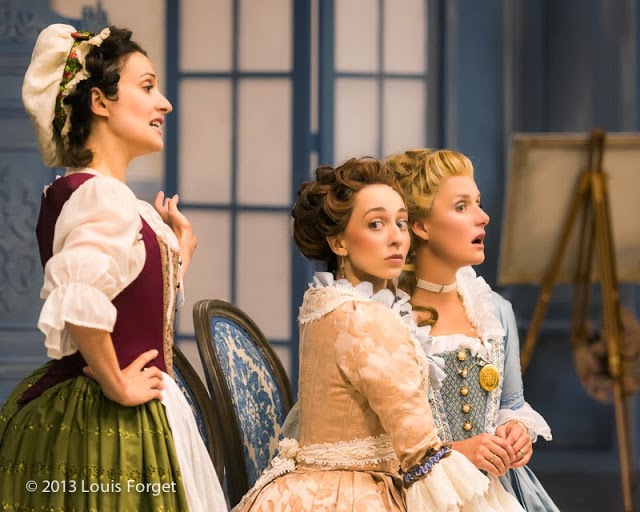
Staskiewicz and Dobson

Blandine Staskiewicz was a perpetually guilty-looking Dorabelle with fruity tone and excellent comic timing. As Fernand, Antonio Figeuroa’s compact, somewhat nasal tenor made “Un aura amorosa” relaxed and almost disarmingly easy, but he didn’t seem to embrace the period style as fully as the rest of the cast and came across as quite modern. Alex Dobson was a natural comedian as Guillaume, if not always an elegant singer. As Delphine (Despina), Claire Debono had a chance to be witty and unaffected before everyone else, and her bright, focused soprano was one of the only I could hear working in a large opera house. Bernard Deletré’s Don Alfonso got some of his theatrical thunder stolen by Jeffrey Thompson mute artist.

The production’s second half was Les femmes vengées, a 1775 comic opera by François-André Philidor (today better known for his chess moves). It has a somewhat similar plot but predates Così by 15 years. An artist and his wife help two local ladies avenge their straying husbands (both of whom want to sleep with the artist’s wife). The staging made this story happen to the same characters from Così, only several decades later, sort of like the women’s revenge for the trick played on them years ago. (Regency fashions indicated that the French Revolution had transpired in the meantime, but no political references were made.) The artist was the silent figure from Così, now married to Delphine, and the two troubled couples are, of course, the lovers, who are now married.

The opera’s libretto, by Michel-Jean Sedaine, is surprisingly subtle in its development of the characters–well, subtle according to the standards of sex comedy, at least–but the problem is that the music isn’t. Philidor’s arias are charming and bright and pretty, but there’s little happening between words and music, and the kind of dramatization that makes the Da Ponte operas so incomparable is basically absent. (You can look at a first edition of the score online here if you’d like to see what eighteenth-century French engraved sheet music looks like or check out the score.) The same cast sang well and acted with rather more slapstick than in the Mozart. Debono’s role as the artist’s wife was more or less the central one, and her rhythmic acuity made the music come to life. As the artist, Jeffrey Thompson sang with a very slender but flexible tenor.
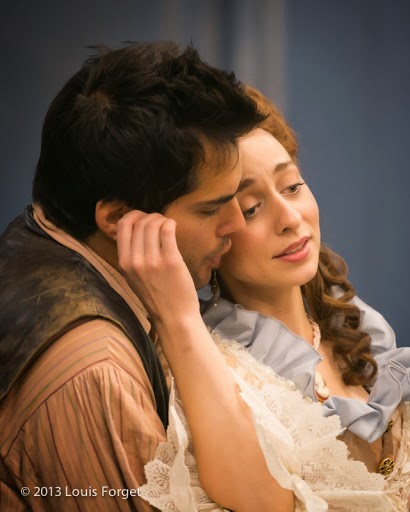
Beaudin and Figueroa

So it is supposed to be a lustiges Nachspiel, but it doesn’t quite work. The contrast isn’t between comic and serious (like in, say, Ariadne auf Naxos) but rather two separate styles of composition. It’s also all rather long: two operas in one evening, neither of which are short, is just more than one really needs. One is loathe, however, to cut any more of Così–the recits cut off some time, and we already lost Dorabella’s Act 2 aria and all of the optional Ferrando ones. (I unfortunately missed the end of Les femmes vengées, and I apologize for this, but the press person gave me a running time that proved to be incorrect by well over an hour. I stayed an hour longer than I expected until imperatives of public transportation compelled me to sneak out. Had I known the proper time I would have been prepared.)

Opera Lafayette doesn’t have the resources to operate on the level of a European group like Les Arts Florissants or the Theater an der Wien, but it’s nice to see an American ensemble trying something ambitious and creative in the pre-1800 realm.

Program Notes Plaudits
(the opposite of a Program Notes Smackdown): Nizam Peter Kettaneh’s notes are excellent.


“The French Così.” Mozart, Così fan tutte and Philidor, Les femmes vengées. Opera Lafayette at the Rose Theater, 1/23/2014. Conducted by Ryan Brown

Continue Reading

Dissertation Completion Hiatus

I have to finish up my dissertation and am going to put this blog on hold for a few months. I will be covering Opera Lafayette’s Mozart/Philidor program, The French Così, this week, and then I will return in the spring a PhD (or at least one waiting for her defense). I reserve the right to state my opinions on the new Met productions of Prince Igor and Werther, but probably nothing else. The timing is poor because there are many interesting events coming up but, alas, the semester is short and the dissertation is long.

I recently received a request for “more GIFs.” Here you go.

Continue Reading

Maus Haus

I spent last week in Vienna working on my research and avoiding the Wiener Staatsoper (you remember what happened at our last reunion?). So it was a little funny to return to New York only to go see that most echt-Viennese of works, Die Fledermaus, now in a new production at the Met. There was, however, very little Viennese about this performance–which isn’t a problem in and of itself. The problem is that it is boring, unfunny and musically not very good.


Strauss II,
Die Fledermaus, dialogue by Douglas Carter Beane and song texts by Jeremy Sams. Conducted by Adam Fischer with Susanna Philips (Rosalinde), Christopher Maltman (Eisenstein), Michael Fabiano (Alfred), Jane Archibald (Adele), Paulo Szot (Falke), Anthony Roth Costanzo (Orlofsky), Danny Burstein (Frosch)

As you may be aware, my research deals with Viennese operetta. Die Fledermaus is earlier than most of what I write about (my dissertation is on the twentieth century while it dates from 1874), but I know the piece well. I do not intend to inveigh against this Met production on charges of historical authenticity and anachronism. While operetta was created for a very specific cultural milieu, it has also been rewritten and transposed and altered as long as it’s been around. I don’t even mind the very mainstream, commercial face of this production. Though it’s not really my cup of tea, and I think a non-profit like the Met should be devoted to more artistic endevours, it is what operetta has basically always been. (Even the careful display of luxurious clothes and furniture is true to style–many operettas would advertise in the program which dressmaker and tailor were responsible for the fashions onstage.)

The production is moved up from 1874 to New Year’s Eve 1899, to transmit a society on the brink of changing many digits in their date. The setting is also moved to Vienna.* This seems to be purely an aesthetic choice, because 1900 costumes are more glamorous than those of a few decades earlier. (If the date is actually supposed to mean something apocalyptic, I would suggest claiming that it is July 27, 1914.) It’s a visually striking Jugendstil production (designed by Robert Jones) that isn’t afraid to cut the Met’s vast stage into a living room size, features some fake Klimts in Act 1, an impressive Seccession dome in Act 2 (see above), and a vaguely Otto Wagner-like jail in Act 3. It’s opulent and, in the Met repertoire, unique in its look. Yet nothing in the performances and text are as classy as this design.

Because the new text is bad. Jeremy Sams’s English lyrics and Douglas Carter Beane’s new dialogue are long-winded–the dialogue goes on for ages, and the lyrics pack in way more syllables in than the music seems to want–and terribly confused in terms of tone and setting. They mix a casual, contemporary tone (“One pig’s head coming through!”) with second-rate Downton Abbey period style and lots and lots of Gilbert and Sullivan couplets. The lyrics’ rhyme schemes and repetition don’t respect the music’s phrase structure, and many of the best lines are completely left out (“Glücklich ist, wer vergißt, was doch nicht zu ändern ist”–Alfred’s toast, “Happy are those who forget that which cannot be changed”–is now “long ago and far away… [something else along the lines of ‘don’t you remember, dear’]”).

The end result is that the production, like Adam Fischer’s unfortunate conducting, doesn’t seem to be located in any place at all. The consistent disregard for fin de siècle tone and manners moves the text away from the period depicted visually, but nor are the contemporary bits strong enough to put it in our day either, and it ends up in the kind of no-place that exists solely onstage at a major opera house. The cast can’t even agree if “Eisenstein” is to be pronounced like it is in German or in English. Like Sams’s previous Met concoction, The Enchanted Island (returning to the Met this spring, God help us all), it is distant from any recognizable social world or human feelings, because apparently it’s more FUN when we forget about that kind of messy stuff. There’s no heart in any of the characters, and no creative impulse, only smug superficiality. The reconciliation at the end has no resonance whatsoever. I felt like someone was screaming at me, “You’re having fun! You’re having fun!” I wasn’t.

And nothing like a few jokes about prison rape to lighten things up, right? I didn’t take notes so I can’t quote much, but much of it is in rather poor taste, extremely dated (this week’s Colbert bit on François Hollande had better French jokes), or otherwise just dumb. The Eisensteins speak in Yiddish dialect, but making them assimilated Jews, um, slightly oversimplifies a rather complex cultural identity in fin-de-siècle Vienna and, particularly considering their subsequent fate, that seems rather questionable. (It does, however, semi-justify the script’s divorce references–divorce was legal for Jews but not for Catholics. Somehow I doubt that was a major factor in the decision.)

There is simutaneously a would-be subversive gay humor element in Orlofsky that ends up turning out as a cape-twirling caricature. One has to wonder how much subversion is going on when the stage is simlutaneously decorated with (fake?) unclothed chorus girls. (Similarly, the casting of a man as Orlofsky is much less disruptive than a woman would be.) This is a production that wants to be outrageous without offending anyone, which doesn’t really work.

(It occurred to me while writing this that the model might have been the musical version of The Producers, to which many references are made. The Viennese sense of humor, however, often depends on a decorously unspoken gap between what is being said and what we all know to be true [welcome to theater under the red pencil of a police censor]. Moving it into this kind of blatantly direct, brash, flashy quasi-New Yawkese doesn’t do either Johann Strauss II or Mel Brooks any favors.)

Anyway, all this might have been improved if the cast had been more adept at selling the weak text, but they’re opera singers and not actors and you can tell. Adam Fischer’s conducting never waltzed, lacking any idiomatic sense for Viennese dance rhythms and making the champagne more or less flat. Nor did the singers seem to be, mostly, well-cast. Susanna Philips has a sweet, winning presence, but she lacks the pizzazz and jaded diva quality for Rosalinde. While her silvery soprano is the right sound for the music, she struggled with the higher passages and particularly the csárdás. Christopher Maltman was a not particularly charismatic Eisenstein (with a British accent hiding just under the surface) and, like most baritones, found the role too high. Paulo Szot sounded growly as Falke, nor was he as naturally charming as he usually is. Patrick Carfizzi sang very well as Frank.

The cast’s brightest spot was Michael Fabiano’s ridiculous Alfred. Granted, it’s a character role and he probably had the easiest material to work with, but he was also by far the funniest and the best sung, easily turning out many high notes. When is the Met going to give him the leading role he so obviously deserves? Anthony Roth Costanzo knows how to say a punch line with a ridiculous Russian accent, but the music is too high for his countertenor and is far better sung by a mezzo and the campy characterization grated. Jane Archibald sang Adele well, with a pleasantly full voice for a coloratura, though she was not quite as adept in the spoken portions. Danny Burstein is a real comedian and his Frosch managed something much closer to funny that most of the show, though he still went on for a few minutes too long. (All of Act 3 was a slog except Adele’s aria, which Archibald sang gracefully.)

You might have a nice ‘Maus if you were to take this sets and costumes and restore Haffner and Genée’s original text and redo the Personenregie. Or you could even adopt David Pountney’s widely-used, mostly totally OK English translation. (It’s on this Glyndebourne DVD.) Maybe consider this for the first revival, Met?

Die Fledermaus continues through February. If you want a culturally perceptive Fledermaus on DVD you really should try Hans Neuenfels’s brilliant 2001 Salzburg deconstruction; if you want a stellar performance of the score you need the Carlos Kleiber DVD from Munich.

Appendix: Program Notes Smackdown
I do not wish to reproduce Chapter 1 of my dissertation in this space, but program notes author Jay Goodwin’s characterization of the source material’s French heritage as “ironic” and as its French background as needing to be “washed away” misdates the anti-French backlash in Viennese theater. For the Viennese in 1874 (when Fledermaus premiered), operetta was French and a French-ish source with the dramaturgy of French boulevard theater was only to be expected. While some anti-French sentiment had already been brewing, it didn’t really catch on in theater production until around a decade later. The founding text of the anti-French nationalist backlash, Adam Müller-Guttenbrunn’s “Wien war eine Theaterstadt,” wasn’t published until 1885. Godwin also oversimplifies his description of Offenbach, who was not a wholly novel foil for large-scale opera as stated but rather refreshed a pre-existing tradition of Volkstück, Schwank, and komische Oper. He also mistakenly states the operetta’s setting as Wien, when it is a “Badort in der Nähe einer großen Stadt,” as mentioned in my footnote below.

*You might also be interested to know that Fledermaus doesn’t originally take place in Vienna!  It’s set in a spa town “near a large city,” probably meaning Baden bei Wien. That’s why Orlofsky is there–he’s taking the waters to cure his ennui.

More photos, all copyright Ken Howard:

Continue Reading

La forza della Bavaria

Was it mere coincidence that both operas I saw during my holiday weekend in Germany both considered free will and fate? Or was it…. something more? Meh. There’s none of Hans Neuenfel’s ambiguity on the fate question in the Bayerische Staatsoper’s production of La forza del destino. For director Martin Kusej, fate as explication–particularly when wielded by organized religion–is a handy tool of oppression by the powerful. It’s an interesting production, and more notably this was an unusually excitingly sung production of an exceedingly tricky opera.


Verdi, La forza del destino, Bayerische Staatsoper, 5 January 2014. Production directed by Martin Kusej, set designer Martin Zehetgruber, costumes Heidi Hackl, lights Reinhard Traub. Conducted by Ascher Fisch with Anja Harteros (Leonora), Jonas Kaufmann (Alvaro), Ludovic Tézier (Carlo), Nadia Krasteva (Preziosilla), Vitalij Kowaljow (Marchese di Calatrava/Padre Guardiano), Renato Girolami (Melitone)

Let me start off by saying that my review of the production is a bit limited, because my view of the stage was a bit limited. I was not too badly put out by this, because I managed to snag a ticket to a ridiculously sold out production only two weeks ahead of time and it cost all of 15 Euros. But I recognize that it is not ideal for a review. (I didn’t watch the webstream.)

I love Forza; I think it’s a fascinating and ridiculously underrated piece that presents enormous musical and dramatic interest and possibilities. (I’ve written about it before.) The, er, “plot” is convoluted and sometimes seems to entirely disappear, as do major characters for acts at a time; the tone swings wildly between the most solemn late Verdi drama and La fille du régiment. It’s the biggest argument against Verdi as a dramatist who operates solely in simple and literal terms. He obviously has more abstract fish to fry here, and a staging that doesn’t reflect this complexity… well, maybe that’s why this opera’s reputation is so bad.

Martin Kusej’s production does make a real attempt at dealing with meaning, though in the end I found it to be something of a hedgehog at loose in a fox of an opera. Like the everpresent table onstage, everything comes down to the destructive effects of patriarchal and religious authority and control. We being with a solemn family dinner at that table, presided over by the Marchese with a prominently placed cross (above). In contrast, Leonora’s forbidden boyfriend Alvaro is quite disreputable-looking and seems to exist well outside the system.

Act 2 seems to be constructed of remanants of this first act in a dream-like way–Leonora’s maid Curra becomes Preziosilla, Carlo grows up (and eventually loses the dorky green sweater), the Marchese becomes the Padre Guardiano, and one of the mysterious dinner guests turns out to be Melitone. Leonora still can’t escape, it seems, and finally submits to the Church (as represented by her dead father, the Marchese/Padre Guardiano) in a baptismal dunking apparently lifted from an American church.

The Act 2 inn set evokes a 9/11 disaster photo, prefiguring the American tone of Act 3, which leaves Leonora for an Iraq-like war. This act begins with a startling tableau of images familiar from the US in Iraq. It’s an apt setting for a chaotic conflict that depends on personal trust. (For an American for whom such things remain open issues, the torture stuff felt underexamined and gratuitous–I don’t think I’m ready to see anything about this as a symbol yet. But it was gone fairly quickly.) The staging of the Alvaro and Carlo scenes, however, is strong and intense (what I saw of it).

The music of the following crowd scenes turns comic but the production remains grim, an orgy that seems ordered out of a Regietheater catalog. This made the production seem a bit deaf to the score’s change of tone, and besides I never got any good sense as to who these people represent or what they’re doing here. While their random appearance and manic energy—were the conductor to become a little more energetic, that is—could seemingly be mined for something grotesque and extreme, here it’s a bit generic and deflated. Even a striking scene of rows of dead bodies in the Rataplan is somehow less horrifying than it should be. (Honestly, after an Abu Gharib tableau, I’m not sure if you have anywhere to go.) The production’s low point comes in the opening of Act 4, which seems to have slipped Kusej’s mind entirely. (Act 3 is rearranged, with the Alvaro-Carlo duet moved after the Rataplan.)

Fortunately, the last act is more effective. Alvaro can’t talk Carlo into forgiveness and Leonore, adrift on a giant pile of white crosses, is not granted her wish for peace. While the Marchese/Padre Guardiano does his blessing duty, Alvaro is no longer convinced of the redemptive power of faith, and ends up throwing one of those crosses on the ground and leaving in despair.

While this production was interesting, the performance’s biggest reward was the singing, more glamorous, charismatic, and committed than you usually hear in this rep. If only the cast hadn’t been consistently counteracted by Asher Fisch’s uninspired conducting. While he and the orchestra got off to a strong prelude, elsewhere he proved too laid-back for his own good, failing to build to climaxes and lacking in energy. This particularly dogged the choral scenes, which tended towards the limp. The chorus, though, was excellent.

Anja Harteros deservedly received the largest ovation for her Leonora. The role suits both her big, dark, slightly grainy soprano and her introverted temperament: she always seems conscious and in control of everything she does, and Leonora here is someone who has never been able to express herself freely. While she doesn’t have the vocal warmth or round sound of a more Italinate soprano, she sounds absolutely like herself and is wonderfully musical. While she doesn’t always have the greatest high notes, the ending of her “Pace, pace” was terrific, and she doesn’t shy away from chest voice, either.

No one would accuse Jonas Kaufmann of being Italian either, but his muscular, forceful tenor and surprisingly bright upper range is perfect for Alvaro’s tortured character. He was also endlessly energetic compared to the more withdrawn Harteros (as well as far greasier-looking compared to her elegance). “Tu, che in seno agli angeli” featured some terrific high soft singing. As Carlo, though, Ludovic Tézier was somewhat overparted and sometimes resorted to barking, as well as struggling with the fioriture in “Urna fatale.” He did his best singing in the duets with Kaufmann, where they blended well.

The supporting cast was good: I kind of wondered what had happened to Vitalji Kowaljow after I heard him sing a pretty strong Wotan a few years ago, and it turns out he is a solid Verdi bass as well. This was the second time I heard Nadia Krasteva as Preziosilla, and while she has the right kind of spicy tone and sass for it and can hit all the notes loudly, she had an awkward break around the bottom of the staff that impeded her Rataplan. Renato Girolami did nothing to make Melitone seem very necessary, but nor was he annoying.

It’s a shame there isn’t going to be a DVD of this. I’m very glad I got to see it in person.


Trailer:

Photos (copyright Bayerische Staatsoper):

Continue Reading

My eyes! My eyes! (Oedipe in Frankfurt)

What’s a pessimistic old director to do when the opera he or she is directing has an ending that is just too damn redemptive? If you’re Hans Neuenfels and are dealing with George Enescu’s Oedipe, a production currently at the Oper Frankfurt, you chop off the optimistic last act. The result is a tight and well-paced tragedy, set to Enescu’s unique voice.


George Enescu, Oedipe. Oper Frankfurt, 1.3.2014, production by Hans Neuenfels, conducted by Alexander Liebreich with Simon Neal (Oedipus), Magnús Baldvinsson (Tiresias), Dietrich Volle (Creon), Michael McCown (Shepherd), Kihwan Sim (Phorbas), Tanja Ariane Baumgartner (Jokaste), Katharina Magiera (Sphinx)

Enescu’s score (premiered 1936) is more contrapuntal and solid than many of its contemporaries (say, Szymanowski) and its vocabulary is too wide to easily describe. The chorus plays an important role, there are some colorful effects (whip, musical saw, thunder, etc.), some of it is influenced by folk music, sometimes it sounds like Strauss, and I think I heard some quarter tones. Sometimes there is so much going on that it’s hard to tell where to listen–the aural equivalent of Where’s Waldo. The vocal writing isn’t particularly grateful and the orchestra is the star attraction, but the music does keep the story moving inexorably forward. Enescu apparently specified that the opera should be performed in the local language, which was followed here. The German was fairly intelligible, though the writing can be thick. You can hear a little of the score in the video at the end of this review.

Neuenfels tends to be attracted to and do well with these ambiguously modern settings of ancient stories–see also both his Medea in Corintho and König Kandaules. While many people  say they would not like to encounter an unfamiliar opera in a production by a Regietheater director like Neuenfels, I don’t think that problem ever came up for me in any of these performances. (Enescu’s opera was probably familiar to a few not-me audience members, but in popularity terms all three are a long way from La traviata.) Neuenfels’s telling of the story is inextricable from his interpretation of it, and the result is elegant, insightful, and perfectly clear without being too obvious–particularly so in Oedipe, which I liked the most out of these three.

Rifail Ajdarpasic’s set frames the action in chalkboards full of physics equations and mathematical jottings, preparing the action’s portrayal of Oedipe as a kind of scientist or archeaologist. In the opening, he gets to watch himself being born–hatched from an egg, in fact. While he is, evidently, investigating the notion of free will, he seems quite suggestible himself: the revelation of his dire fate is enough for him to give his supposed mother a big kiss on the lips.

This should indicate that Edmund Fleg’s libretto is no normal Oedipus: it tells the title character’s whole biography, not just the last part (or, in this production, up to the eye-gouging). He goes to Corinth, he plays Twenty Questions with the Sphinx, and he returns to Thebes. The big cut gives the opera a strikingly symmetrical structure, with Oedipe’s final Act 3 denouement echoing the revelations of Act 1. Simultaneously, the gender ambiguity of the extravagant costumes (Tiresias seems to be heading towards feminity a little bit early, or late (?), but he is joined by the whole chorus) suggests Freudian paths–we are, after all, dealing with the ur-Complex. Neither opera nor production offers any pat lieto fine, but one suspects that Oedipe’s triumphant declaration to the Sphinx that man is greater than fate may have been off base.

I was very impressed by the overall level of the Oper Frankfurt’s orchestra and ensemble of singers, as well as Alexander Liebreich’s conducting. (I’d never visited this opera house before.) I was sitting right up in the front and heard a good deal of the orchestra, which (though I say this without any detailed knowledge of the score) sounded very accurate and balanced. Baritone Simon Neal made a suitably intense and tortured Oedipe, almost exacerbated by his outwardly normal appearance. I particularly liked Tanja Ariane Baumgartner (Jokaste), who has a very rich and even mezzo. The Sphinx’s crazy scene is really too low for Katharina Magiera, who sounded like she’d borrowed her lower notes from Marlene Dietrich, but she vamped with committment. Supporting roles were also strong.

I hope we can hear this opera more often. Has Leon Botstein seriously not done this one yet?

Video:

More photos (all copyright Monika Rittershaus): 

Continue Reading